¡Felicitaciones al Congreso de la República! Leo que “Los diputados al Congreso confirmaron en 2006 que, en su mayoría, no son productivos. Treinta y ocho, de los 158, no presentaron iniciativas de ley, y 55 sólo incluyeron su nombre en propuestas grupales, de hasta 15 colegas”. Sigan con el buen trabajo. Detengan la diarrea legislativa.
Monthly Archives: diciembre 2006
22
Dic 06
¿Qué harías por la ciencia?
Hoy es el Día Global del Orgasmo, cuyo propósito es “afectar positivamente el campo de energía de la Tierra por medio de la energía humana emanada durante un Orgasmo Global sincronizado”. Francamente yo no creo en esas cosas; pero, ¡Hombre!, este es un experimento “científico” en el que no me molesta ser conejillo de Indias.
21
Dic 06
¡Nacimiento!
 Hoy empezó a llegar la Navidad a mi casa, con el Nacimiento, el pinabete, la manzanilla y las chichitas. ¡Feliz Navidad a todos!
19
Dic 06
Otra negación de la propiedad privada
En Guatemala los postes para la transmisión de la energía eléctrica son propiedad de las empresas distribuidoras. Sí, pero no. Los políticos, que pueden utilizar la majestad de la ley para imponerse sin necesidad de utilizar la fuerza en forma evidente, pretenden que aunque los postes sean “propiedad” de las empresas distribuidoras, ellos, los políticos, pueden utilizarlos a su antojo para la propaganda política, sólo porque han fabricado una ley que les permite usar y abusar de la propiedad ajena. La perversión de la ley, en el sentido de usarla para imponer intereses particulares sobre los derechos individuales no es un fenómeno extraño en Guatemala; pero ¿por qué permitimos que siga ocurriendo?
¡La EEGSA y cualquier otra persona, tiene todo el derecho del mundo a oponerse a que su propiedad sea usada para fines ajenos!
18
Dic 06
Cuando se muera Castro
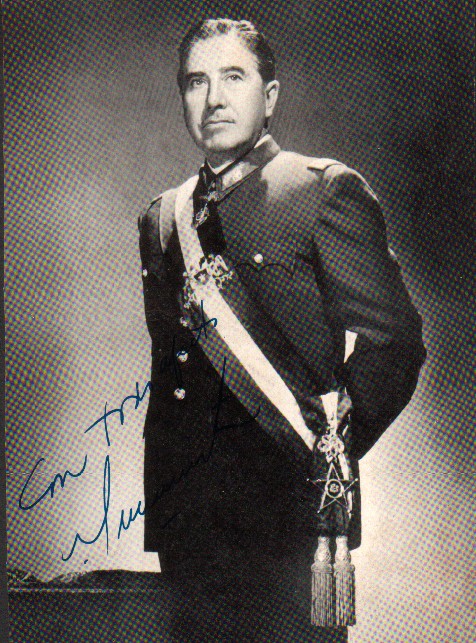
Cuando se muera Fidel Castro, los socialistas y sus amigos ¿armarán escándalos por los más de 9,000 cadáveres que él dejó atrás? (Sin contar a los miles que han muerto al tratar de escapar de su isla prisión.) Esos escándalos, ¿será iguales a los que han hecho por los 3,000 muertos que se le atribuyen a Augusto Pinochet? Claro que un sólo asesinado es un muerto de más; pero uno quisiera ver esa clase de consistencia, ¿o no?
Esta foto, ca. 1978, me la envio Pinochet cuando yo coleccionaba fotografías autografiadas de jefes de estado y jefes de gobierno. Y como yo sí soy consistente, también tengo una del dictador socialista Nicolae Ceaucescu. Hasta tengo una de Jimmy Carter (¡Yuck!).
He aquí el mejor obituario de Pinochet que he leído. Su autor es George Reisman, autor de Capitalism, A Treatise on Economics, www.capitalism.net:
On Sunday, December 10, General Augusto Pinochet of Chile died, at the age of 91. General Pinochet deserves to be remembered for having rescued his country from becoming the second Soviet satellite in the Western hemisphere, after Castro’s Cuba, and, like the Soviet Union, and Cuba under Castro, a totalitarian dictatorship.
The General is denounced again and again for the death or disappearance of over 3,000 Chilean citizens and the alleged torture of thousands more. It may well be that some substantial number of innocent Chilean citizens did die or disappear or otherwise suffered brutal treatment as the result of his actions. But in a struggle to avoid the establishment of a Communist dictatorship, it is undoubtedly true that many or most of those who died or suffered were preparing to inflict a far greater number of deaths and a vastly larger scale of suffering on their fellow citizens.
Their deaths and suffering should certainly not be mourned, any more than the deaths of Lenin, Stalin, and Hitler, and their helpers should be mourned. Had there been a General Pinochet in Russia in 1918 or Germany in 1933, the people of those countries and of the rest of the world would have been incomparably better off, precisely by virtue of the death, disappearance, and attendant suffering of vast numbers of Communists and Nazis. Life and liberty are positively helped by the death and disappearance of such mortal enemies. Their absence from the scene means the absence of such things as concentration camps, and is thus ardently to be desired.
As for the innocent victims in Chile, their fate should overwhelmingly be laid at the door of the Communist plotters of totalitarian dictatorship.
People have an absolute right to rise up and defend their lives, liberty, and property against a Communist takeover. In the process, they cannot be expected to make the distinctions present in a judicial process. They must act quickly and decisively to remove what threatens them. That is the nature of war. The fate of innocent bystanders, largely those who cannot be readily distinguished from the enemy, is the responsibility of the Communists. Had they not attempted to impose their totalitarian dictatorship, there would not have been any need to use force and violence to prevent them, and thus the innocent would not have suffered.
Contrary to the attitude of so many of today’s intellectuals, Communists do not have a right to murder tens of millions of innocent people and then to complain when their intended victims prevent their takeover and in the process kill some of them.
General Pinochet was undoubtedly no angel. No soldier can be. But he certainly was also no devil. In fact, if any comparison applies, it may well be one drawn from antiquity, namely, that of Cincinnatus, who saved the Roman Republic by temporarily becoming its dictator. Like Cincinnatus, General Pinochet voluntarily relinquished his dictatorship. He did so after both preventing a Communist takeover and imposing major pro-free-market reforms, inspired largely by Milton Friedman (who in large part was himself inspired by Ludwig von Mises). The effect of these reforms was to make Chile’s the most prosperous and rapidly progressing economy in Latin America, Thereafter, in the words of his New York Times’—largely hostile—obituary, he used his remaining power to “set limits, for example, on economic policy debates with frequent warnings that he would not tolerate a return to statist measures.”
General Pinochet was thus one of the most extraordinary dictators in history, a dictator who stood for major limits on the power of the state, who imposed such limits, and who sought to maintain such limits after voluntarily giving up his dictatorship.
When General Pinochet stepped down, he did so with a guarantee of immunity from prosecution for his actions while in power. However, the present and previous regime in Chile violated this agreement and sought to ensnare the General in a web of legal actions and law suits, making the last years of his life a period of turmoil. This was a clear violation of contract, comparable to the seizure of property in violation of contract. Not surprisingly the regimes in question were avowedly socialist. As a result of their breach, it is now considerably less likely that the world will soon see any other dictator voluntarily relinquish his power. The Chilean socialists will have taught him that to be secure, he must remain in power until he dies.
Dictatorship, like war, is always an evil. Like war, it can be justified only when it is necessary to prevent a far greater evil, namely, as in this case, the imposition of the far more comprehensive and severe, permanent totalitarian dictatorship of the Communists.
Despite the fact that General Pinochet was able to use his powers as dictator to enact major pro-free-market reforms, dictatorship should never be seen as justified merely as a means of instituting such reforms, however necessary and desirable they may be. Dictatorship is the most dangerous of political institutions and easily produces catastrophic results. This is because a dictator is not restrained by any need for public discussion and debate and thus can easily leap headlong into disasters that would have been avoided had there been the freedom to criticize his proposed actions and to oppose them. And even when his policies may be right, the fact that they are imposed in defiance of public opinion operates greatly to add to their unpopularity and thus to make permanent change all the more difficult.
On the basis of such considerations, when asked many years ago what he would do if he were appointed dictator, von Mises replied, “I would resign.”
—–
This article is copyright © 2006, by George Reisman. Permission is hereby granted to reproduce and distribute it electronically and in print, other than as part of a book and provided that mention of the author’s web site www.capitalism.net is included. (Email notification is requested.) All other rights reserved. George Reisman is the author of Capitalism: A Treatise on Economics (Ottawa, Illinois: Jameson Books, 1996) and is Pepperdine University Professor Emeritus of Economics.
18
Dic 06
Otra sinvergüenzada en el Congreso
Los funcionarios deberían de vivir bajo las leyes que promueven; y los diputados deberían no sólo vivir bajo las leyes que aprueban, sino que deberían pagar los tributos que imponen. Claro, como no es así, entonces pasa lo siguiente:
Aquí en Guatemala, los “funcionarios, desde hace varias administraciones, han puesto en práctica la receta perfecta para salir airosos: tributar poco y recuperar todo lo que puedan.
Diputados, ministros o burócratas de primer nivel devengan sueldos elevados, pero a la hora de hacer cálculos para tributar, las cifras los colocan, en algunos casos, al nivel de trabajadores con sueldo promedio”, según fue revelado hoy.
¡No hay derecho!
18
Dic 06
Para Ripley: racismo y privilegios
“La sentencia de la Corte Suprema de Justicia, que en el 2005 decretó que a una persona juzgada por sistema indígena no se le puede volver a juzgar por el occidental, es el primer caso de reconocimiento del derecho maya.
Un hombre que fue acusado por la comunidad de haber robado un vehículo, pero que lo devolvió al ser descubierto, fue sentenciado por el sistema indígena a servicio comunitario y a reconocer su falta públicamente. Como era confeso, la Policía Nacional Civil lo detuvo, y el Ministerio Público pidió ocho años de cárcel para él.
Finalmente fue sentenciado por robo. La Defensa Pública Penal, asesorada por varias organizaciones, pelearon el proceso, y en casación, la Corte Suprema de Justicia dictaminó que si ya había sido juzgado por un sistema, no podía volver a ser acusado.
Esta resolución sentó un precedente legal sobre la legitimidad del derecho indígena y su coexistencia con el oficial”, dice un reportaje de hoy y las negritas son mías.
Hasta aquí llega, oficialmente, la igualdad de todos ante la ley en Guatemala. Como están las cosas, si alguien se roba un carro ¡y lo devuelve al ser descubierto!, tiene dos opciones: se acoge el sistema occidental y corre el riesgo de pasar 8 años en la cárcel, o se somete al drecho maya y hace algunas tareas indefinidas luego de pasar una vergüenza. Usted, ¿qué preferiría?
Pero la cosa no se queda ahi. ¿Puede, un ladron ladino someterse al derecho maya? ¿Cuánto de sangre maya debe tener uno para someterse a la opción más benigna? Si el derecho maya es sólo para los mayas, ¿viola el principio de igualdad de todos ante la ley? Si asi fuere, de plano que es un privilegio. Y si lo fuere, ¡es un privilegio basado en la étnia! En esas condiciones, ¿es un privilegio racista? ¿Es excluyente?
Yo digo que sí. Es excluyente, es racista, es un privilegio y viola el principio de igualdad de todos ante la ley. ¿Qué ladrón atrapado, en sus cinco sentidos, no quisiera recibir la pena más benigna? y ¿Qué pasará si el ladrón vuelve a ser atrapado robando, o cometiendo algún otro delito?
Si la práctica de este “derecho indígena” está siendo promovida por la embajada de Noruega y por la gente de Cirma, ¡y avalada por la Corte Suprema de Justicia!, la muerte oficial de la igualdad de todos ante la ley, en Guatemala, ya tiene responsables.
17
Dic 06
Cero tolerancia, o talvéz no
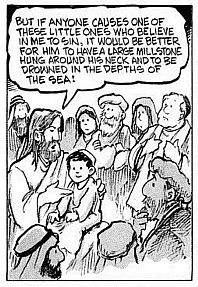

“La Iglesia [Católica] no está dispuesta a aceptar que miembros del clero incurran en faltas consideradas graves por el canon católico, y después de agotar todos los medios de reconciliación, procede a excomulgar a sus miembros”, dice un reportaje publicado hoy.
17
Dic 06
Hipocresía
“Que el mundo gaste más de 500 mil millones de dólares en armas y soldados es una inmoralidad, porque es la última prioridad en el mundo que nos toca vivir”, dijo Oscar Arias, presidente de Costa Rica durante una cumbre centroaméricana celebrada ayer.
Esta afirmación tan cargada viene del mandatario del único país centroaméricano que no tiene ejército; ¡Pero que tiene guardia civil, guardia costera, sección aérea y guardia de asistencia rural!, todas ellas estupendamente armadas. Esto es hipocresía de la fea, ¿o no?